
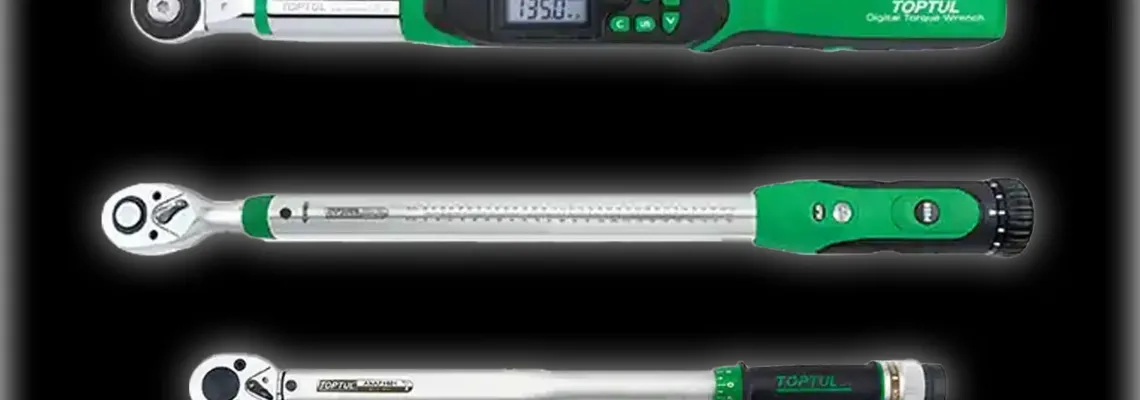
Types of torque wrenches and their use - a complete guide
A torque wrench is one of the most important tools when working on a car, motorcycle or any mechanical structure. It allows bolts and nuts to be tightened with a precisely defined torque, which guarantees reliability, safety and long life of the components.
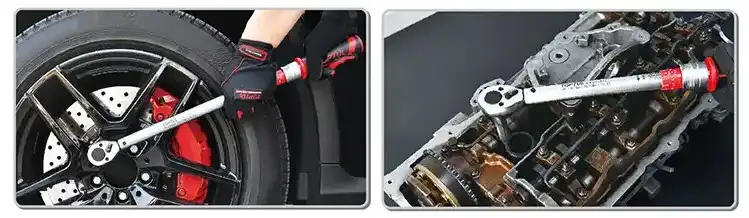
In this article, we will look at what a torque wrench is, how to use it correctly and which mistakes should be avoided.
What is a torque wrench
A torque wrench is a tool that allows bolts and nuts to be tightened with a preset torque.
Torque is usually measured in:
· Nm (Newton meters) - the most commonly used unit
· ft-lb (foot-pound) - used mainly in American engineering
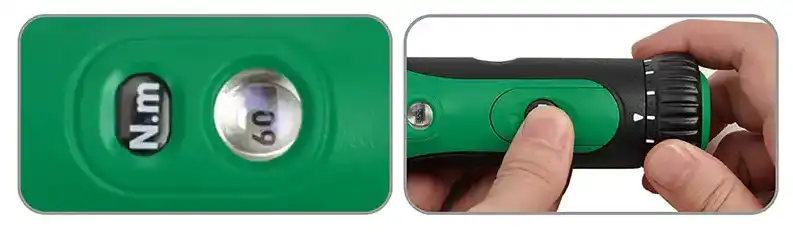
As standard, torque wrenches have a dual scale in Nm and Ft-Lb
When the set torque is reached, the wrench emits a characteristic "click" or signal that indicates that you should stop tightening.
Different torque wrenches have different measurement accuracy.
As a standard, an accuracy of ± 4% of the set value is accepted, but there are also precision versions that read with an accuracy of ± 3% of the set value.
Why is it important to use a torque wrench
The correct torque is extremely important because:
· prevents bolts from breaking
· protects threads from damage
· ensures uniform tightening
· prevents loosening of elements
For example, in cars this is critical for:
· wheel bolts
· cylinder head
· brake calipers
· suspension
· engine components
How to use a torque wrench - step by step
1. Check the required torque
· Before you start, check the car or manufacturer's service manual for what torque is required for the specific bolt.
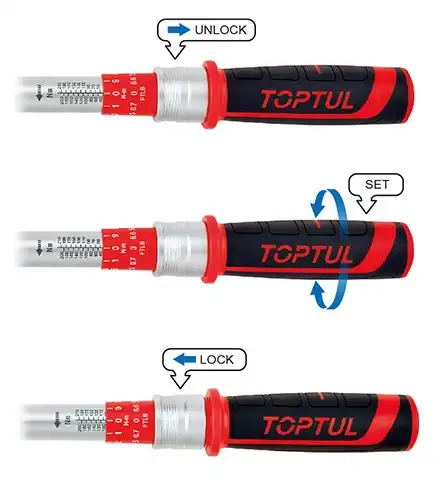
2. Adjust the wrench
· Most torque wrenches have a scale on the handle.
Steps:
· Loosen the locking mechanism at the end of the handle.
· Turn the handle until you reach the desired value.
· Lock the setting.
3. Insert the appropriate socket
· Select the correct size socket that matches the bolt or nut.
· The wrong size can damage both the bolt and the tool.
4. Tighten smoothly
· Place the wrench on the bolt and begin tightening slowly and evenly.
· Do not make sudden movements
· Do not use extensions (tubes)
· Hold the wrench by the handle (some handles have a marker that determines the exact place to apply force)
5. Stop when “clicking”
· When you reach the set torque, the wrench will click or give another signal. At this point, stop immediately and do not continue tightening.
The most common mistakes when using a torque wrench
1. Overtightening after the “click”
· Many people continue to press after the signal. This makes the use of the tool pointless.
2. Using for loosening
· The torque wrench is not intended for loosening bolts.
· Use a ratchet or wrench for this
3. Storing under tension
· After work, always return the wrench to the lowest value.
· This protects the spring from wear.
4. Using outside the range
· Each wrench has a certain range, for example:
5 – 25 Nm
40 – 200 Nm
40 – 210 Nm
· Working outside this range leads to inaccurate results.
Useful tips
✔ Clean the threads of the bolt and nut before tightening
✔ Check the calibration of the wrench periodically
✔ Use a torque wrench with an appropriate range for the specific task
✔ Store the tool in its case in a dry and protected place
Torque wrench calibration
Torque wrench calibration is a process in which the accuracy of the measured torque is checked and, if necessary, adjusted.
Over time and with prolonged use, the wrench mechanism may wear out or change its settings, leading to deviations from the actual value.
Calibration is usually recommended
- once a year if the tool is used regularly
- every 5,000 - 10,000 tightenings
- if there is a suspicion of inaccurate measurements
- after a drop or strong impact on the tool
Calibration is usually performed with specialized calibration equipment (stand), which measures the actual torque that the wrench applies and, if necessary, the wrench mechanism is adjusted to achieve an accurate value.
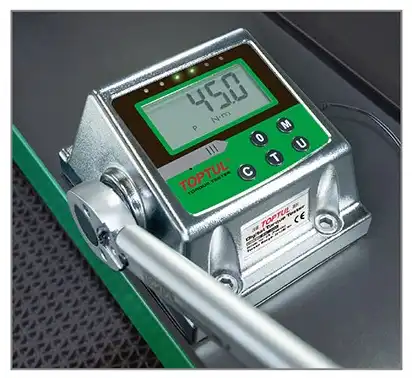
Types of torque wrenches
1. By measuring range
One of the most important criteria when choosing a torque wrench is the torque measuring range. It indicates within what limits the tool can measure and control the tightening force.
Choosing the right range is essential, as working outside this range can lead to inaccuracies or damage to the tool.
Do not choose a torque wrench that will be used primarily at the lower or upper end of the wrench scale.
1.1. Small-range torque wrenches
These wrenches are designed to work with small torque values, usually in the range of approximately 1 – 20 Nm (sometimes up to 25 Nm).
This type of wrench is used where very high precision and delicate tightening are required, such as assembling electronic components, working with small bolts and screws, or fine mechanical operations.
1.2. Medium-range torque wrenches
These are the most commonly used torque wrenches, covering an approximate range of 20 – 200 Nm.
This range is suitable for most standard mechanical operations, such as automotive repairs, engine component installation, suspension bolt tightening, and garage work.
1.3. High-range torque wrenches
These tools are designed to handle high torques, typically in the range of 200 – 1000 Nm or more.
They are more massive and are often used in industrial applications such as heavy-duty machinery, industrial equipment, construction machinery, and the installation of large bolted joints.
1.4. Very high-range torque wrenches
Some specialized tools can reach over 1000 Nm, often using torque multipliers or hydraulic systems. They are used in the energy sector, heavy industry, in the assembly of large metal structures and in the servicing of turbines and industrial machinery.
1.5. Fixed-force torque wrenches
In these, the torque is preset by the manufacturer and cannot be adjusted by the user.
When this preset value is reached during tightening, the wrench mechanism is activated - usually by clicking, sliding or releasing the pressure.
This type of wrench is mainly used in situations where it is necessary to always apply the same tightening force, without the risk of incorrect adjustment.
2. According to the direction of reading
Torque wrenches can also be classified according to the direction in which they measure and read the torque. This is an important characteristic, because in some cases it is necessary for the tool to work only when tightening, and in others - both when tightening and unscrewing.
2.1. Single-direction torque wrenches
These are wrenches that measure torque in only one direction – usually when tightening (clockwise).
They are the most common and are mainly used for standard service operations.
Advantages:
· simpler design
· lower price
· sufficient for most repair work
It is important to know that with these wrenches the measurement is not read counterclockwise.
2.2. Double-direction torque wrenches
These wrenches can measure and control torque both when tightening and when loosening.
They allow for both clockwise and counterclockwise operation.
They usually have a ratchet switch that determines the direction of operation.
Advantages:
· greater versatility
· ability to measure torque counterclockwise
· suitable for more specific service operations
3. According to the size of the square
Torque wrenches can also be classified according to the size of the connecting square. This is the square end to which the sockets are attached.
3.1. 1/4" torque wrench
Typical range: about 2 - 25 Nm
3.2. 3/8" torque wrench
Typical range: about 10 - 120 Nm
3.3. 1/2" torque wrench
Typical range: about 40 - 300 Nm
3.4. 3/4" torque wrench
Typical range: about 100 - 600 Nm
3.5. Torque wrench 1"
Typical range: over 500 Nm
4. Torque wrenches with a protractor
A torque wrench with a protractor is a specialized tool that allows not only tightening with a certain torque (Nm), but also additional tightening at a precisely defined angle (in degrees).
This is especially important in modern engines and mechanical structures, where the manufacturer requires that the bolts be tightened first with a certain torque, and then retightened at a precisely defined angle.
The protractor can be built into the wrench itself or be a separate accessory that is placed between the wrench and the socket.
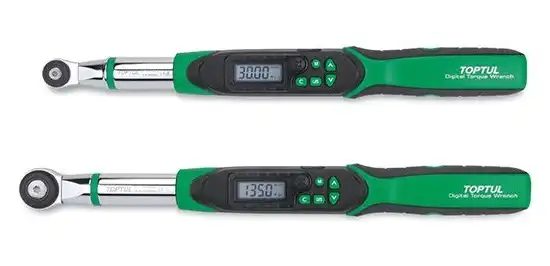
The tightening process is usually carried out in two stages:
First, the bolt is tightened with a torque wrench to a certain torque (for example, 40 Nm).
Then the bolt is retightened at a certain angle – for example, 90° or 180°, which is monitored by the protractor.
This tightening method is called torque-to-angle and is used to achieve very precise and uniform loading of the bolts.
Advantages:
· allows very precise control of the tightening
· necessary when working on modern engines
· ensures uniform loading of the bolts
5. Digital torque adapter
A digital torque adapter is an electronic device that allows measurement and control of torque using a regular ratchet.
It is placed between the tool and the socket, thus turning the standard tool into a torque wrench.
It also supports different units of measurement (Nm, ft-lb, in-lb, kg-cm).
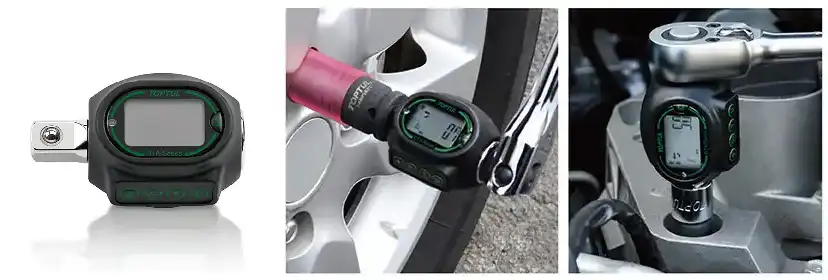
The adapter has the ability to set the desired torque and a digital display that shows its value in real time.
When the preset value is reached, the device usually emits a sound signal, light indication or vibration to warn the user that the required tightening torque has been reached.
Conclusion
A torque wrench is an indispensable tool for any mechanic or automotive enthusiast. Using it correctly ensures accurate tightening, less damage, and safer operation.
If you follow the correct steps – setting the torque, tightening smoothly, and stopping at the signal – you will achieve professional results every time.
You can view the full range of torque wrenches Here.